
The Story Behind 年: From Ancient Knots to Harvest and Renewal
Chinese New Year 2026 — Year of the Horse
What if the meaning of a year could be discovered through the stories hidden in Chinese characters?
As we welcome the Year of the Horse, let's explore how the ancient forms of 年 (year), 冬 (winter), and 终 (end) reveal a remarkable connection between writing, the rhythms of nature, and humanity's enduring traditions of renewal.
Seeing 年 (nián): From Knot Tying to Harvest to Renewal
It's that time of year again. As the lunar calendar turns, we welcome Chinese New Year — 2026, the Year of the Horse. 🐎
The sun retreats, and we enter the quiet season—days grow shorter, nights stretch longer. Snow settles over the frozen earth. Trees stand bare against the winter sky. Icicles glimmer softly beneath the streetlights.
And yet, in this stillness, something awakens.
Across East and West, winter brings celebrations of light, warmth, reunion, and renewal—from Christmas to Chinese New Year. In the coldest, seemingly most lifeless season, we find reasons to gather, remember, and look forward.
Long before writing became widespread, people used knots tied in cords to record and communicate information. Known in Chinese as 结绳记事 (jié shéng jì shì), this ancient practice offers a fascinating connection to the history of Chinese characters.[1]
Consider 冬 (dōng), the character for winter.
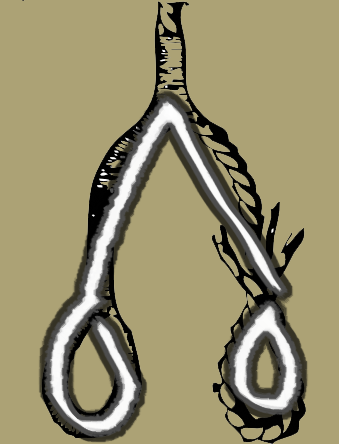
In early Chinese writing, 冬 is commonly interpreted as depicting a cord with knots at both ends, expressing the idea of an ending or completion. It originally shared its form with 終 (zhōng), meaning end or completion. As the writing system evolved, the thread component 糸 was added to distinguish 終, while 冬 developed its specialized meaning of winter.[2]
What a beautiful connection: the end of a cord, the end of a season, and the completion of a cycle.
And from completion comes renewal.
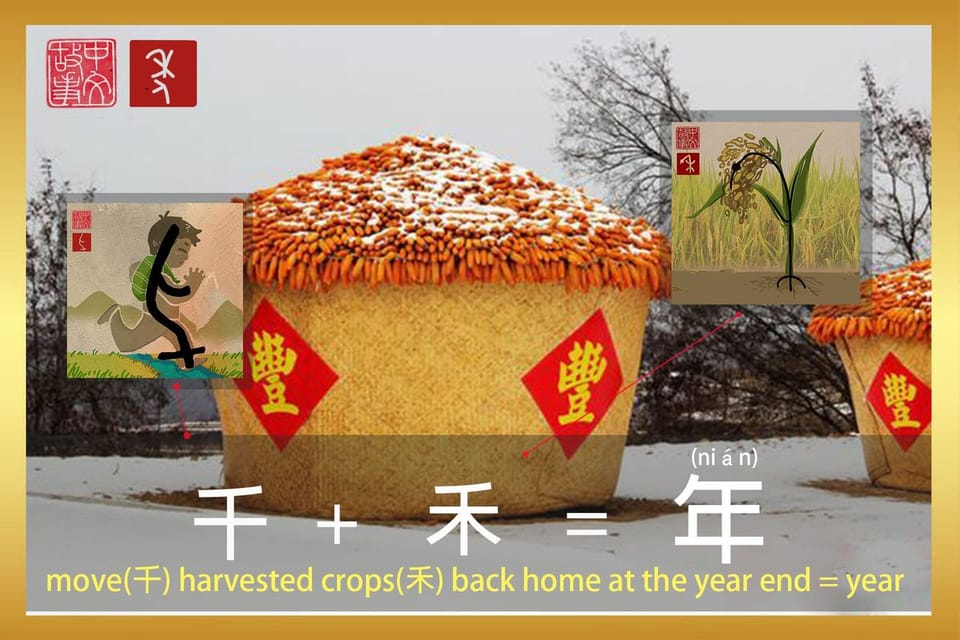
Now consider 年 (nián), the character for year.
Its ancient oracle-bone form depicts a person carrying harvested grain. The image reflects one of the most important moments in an agricultural society: the harvest, when months of labor finally bear fruit.
Over time, the meaning extended from harvest to the annual cycle itself. The character for year thus preserves a connection to the rhythms of agriculture and the passage of time.[3]
From spring's sowing… to summer's growth… to autumn's harvest—winter becomes the season of storing, reflecting, and honoring what the year has yielded.
This is the quiet threshold between what has been… and what is about to begin.
To mark this moment, I've created a watercolor illustration for 年, bringing the ancient visual structure together with a contemporary artistic interpretation.
The illustration invites us to see more than a written symbol. It invites us to rediscover the relationship between language, human experience, and the natural world.
Because learning a language is not merely memorizing symbols. It is entering a system of meaning—and discovering the stories that connect us across generations.
Discovering More Through 年, 冬, and 终
Once you recognize the meanings of these characters, you can begin to explore how they work together in Chinese words and expressions.
1. 冬天 (dōng tiān) — Winter
冬 (winter) + 天 (day, sky) = winter
2. 年终 (nián zhōng) — Year-end
年 (year) + 终 (end) = the end of the year
3. 冬天是一年的年终。
Dōngtiān shì yì nián de niánzhōng.
“Winter is the end of the year.”
4. 一年之终,在冬。
Yì nián zhī zhōng, zài dōng.
“The end of the year lies in winter.”
5. 冬天是年终之时。
Dōngtiān shì niánzhōng zhī shí.
“Winter is the time of the year's end.”
Through just a few interconnected characters, we encounter not only vocabulary but also a way of understanding time: the passing of seasons, the completion of one cycle, and the anticipation of another.
That is the beauty of Chinese writing. Its characters can preserve traces of the world in which they were created—allowing us to rediscover meaning through form, imagery, and story.
Sources & Further Reading
[1] Ancient knot-recording practices (结绳记事)
Taiwan Ministry of Education, Revised Mandarin Chinese Dictionary, entry for 结绳记事.
[2] The historical relationship between 冬 and 終
Chinese University of Hong Kong, Multi-function Chinese Character Database (漢語多功能字庫): 冬 and 終.
[3] The ancient form and agricultural meaning of 年
Chinese University of Hong Kong, Multi-function Chinese Character Database: 年.
Academia Sinica, Chinese Character Evolution Database: 年 — Historical Character Forms.

Comments ()